Integrated plastic parts for appliance and electromechanical assemblies
Appliance mechanisms can combine gears, housings, levers, guides and snap-fit features in a constrained space. Material choice therefore has to account for both mechanical duty and the surrounding thermal, electrical, moisture or chemical environment.
When several functions are integrated into one molded component, identify which interfaces control assembly and which surfaces are cosmetic. This helps keep tolerances focused on the areas that affect the mechanism.

Design review focus
Integrated features
Review ribs, bosses, clips, inserts, bearing seats and gear features as one molded geometry.
环境
Temperature, moisture, detergents, oils or electrical requirements can narrow resin choices.
Assembly sequence
Fasteners, press fits, snap fits and mating shafts should be included in the tolerance review.
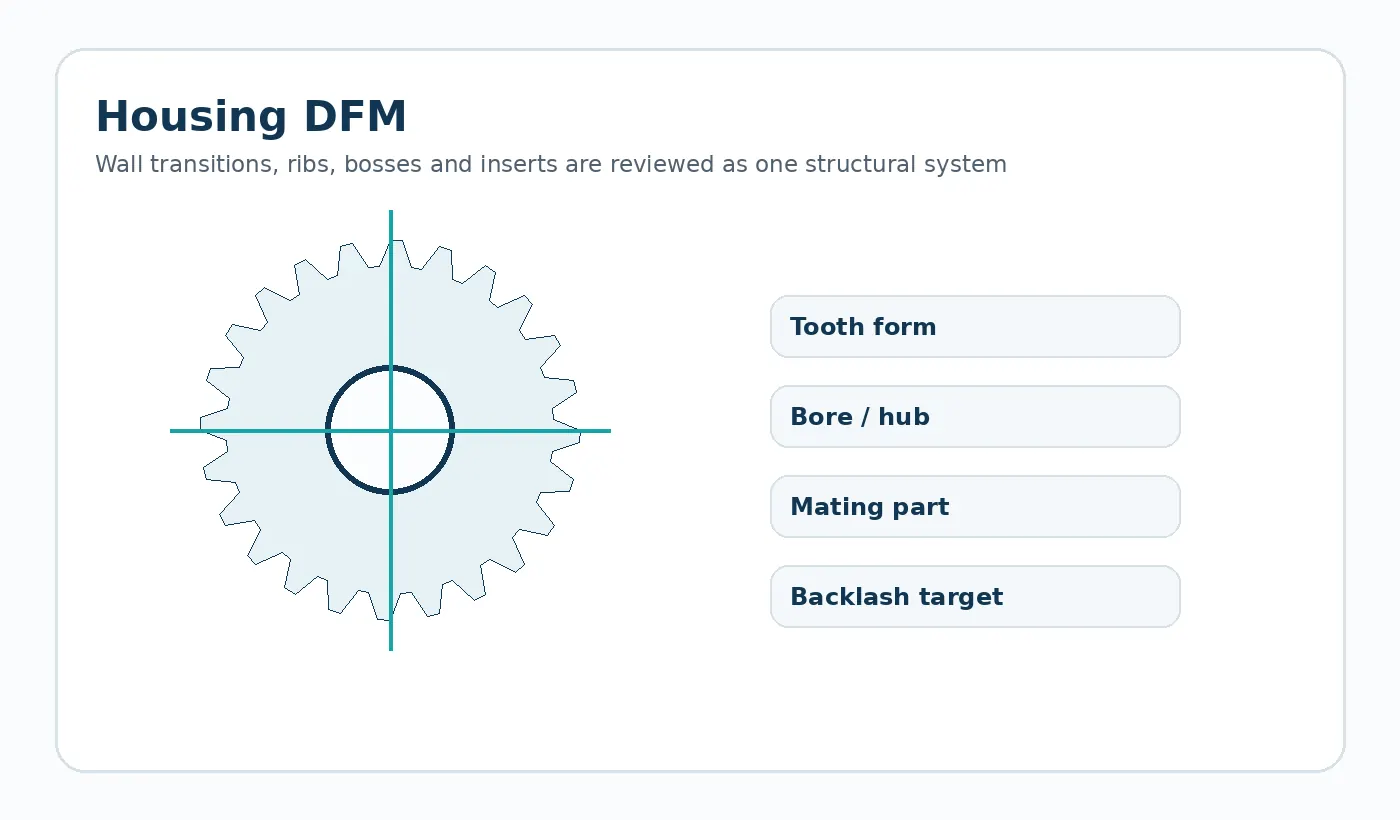
Integrated molded features create coupled tolerances
An appliance component may contain a gear, bearing seat, snap feature and mounting boss in one molding. Each function shares the same shrinkage and warpage behavior, so local fixes can affect another interface. A thicker boss may improve screw strength but move a nearby bearing seat; a gate change may improve filling but shift fibre orientation in a reinforced housing.
Review the full component with the assembly sequence visible. This keeps DFM changes connected to function.
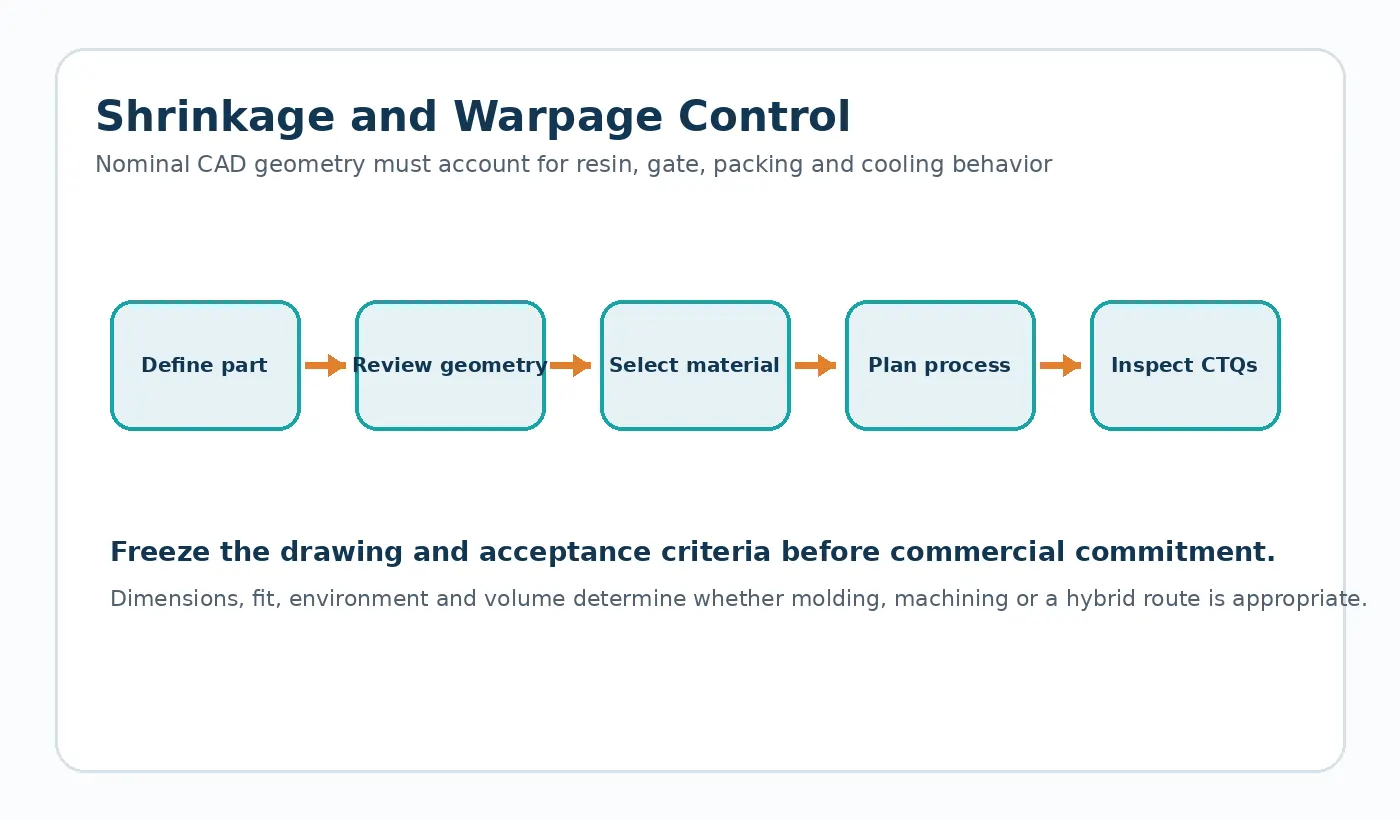
Service environment
Heat from motors or heaters, occasional moisture, cleaning agents and long dwell under load can matter in appliances. For snap fits or spring-like features, creep over time may be as important as initial assembly force.
List the continuous and short-term temperature conditions and identify any chemical exposure. If a resin is mandated by an electrical or flammability requirement, include the exact requirement in the RFQ.
Electromechanical RFQ inputs
- Assembly drawing showing mating parts
- Integrated gear, snap, insert and fastener features
- Thermal and moisture environment
- Electrical/flame/chemical requirements where applicable
- Critical fits and installation sequence
- Production quantity and cosmetic zones
此应用程序的验证计划
首件检验应围绕机床接口展开。确认安装基准、配合部件或链条、预期载荷方向、典型转速/循环模式以及运行环境。如果位置或间隙至关重要,则应在经过典型调校和循环后测量装配后的机构,而不仅仅是批准自由部件。
务必记录下零件图纸上容易被忽略的任何现场限制因素:例如防护罩间隙、清洗化学品、电机附近发热、无支撑齿条跨距、反转工况或固定齿轮中心的轴承布置。这些细节通常可以解释为什么尺寸符合要求的零件在实际使用中表现不同。
Application acceptance rail
Before release, tie the component back to four controls: the operating duty, the mating interface, the environmental condition used for dimensional acceptance and the functional test that represents the real assembly. These controls prevent a nominally correct part from being approved under conditions that do not match service.
Duty
Peak and normal load, speed, reversals, cycle profile and expected service interval.
Interface
Mating geometry, support, alignment, fastener or shaft fit and the datum scheme used for measurement.
Acceptance
Conditioning state, critical dimensions, visual criteria and an assembly or motion check agreed before repeat production.
Information to include in the application review
Document the complete operating envelope rather than only nominal speed or load. Include starts and reversals, worst-case temperature and moisture, cleaning chemicals or lubricants, shaft and bearing support, the mating material, available installation space and any field-replacement constraint. If noise, backlash, wear or positional repeatability is the reason for the project, state that explicitly so the drawing and inspection plan can focus on the real problem.
For first samples, define what will be checked in the component and what will be checked in the machine. A dimensional report verifies the drawing; an assembly or functional test verifies that the selected datums, fits and material condition produce the required behavior. Both are useful when the mechanism is sensitive to cumulative tolerances.