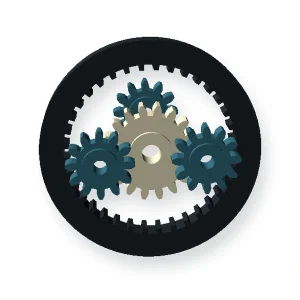
塑料行星齿轮
Planetary gear components for compact multi-gear setsSun, planets, ring gear and carrier geometry must be treated as a system; changing one tooth count can change assembly and mesh conditions elsewhere.Planetary gears share load through several simultaneous meshes. The sun, planets, ring and carrier pin circle must satisfy the same pitch system and assembly relationship; one component cannot be finalized independently.What to define before opening an RFQSun, planet and ring tooth countsModule/DP and pressure angleCarrier pin and bore detailsPhasing and assembly constraintsTorque split, lubrication and backlashCarrier-pin position and ring-gear concentricity are often as important as individual tooth measurements. When noise or load sharing matters, include the assembled test condition in the sample-approval plan.How to use this categoryThe product cards below are linked to the live WooCommerce catalogue for Plastic Planetary Gears. Open the closest geometry first, then compare its RFQ guidance against your drawing. If no listed product matches the interface, use the custom component route rather than forcing the part into the wrong family.Selection data that separates a usable quote from a generic quoteInputRequired definitionSun, planet and ring tooth countsDefine on the drawing or project brief before supplier review.Module / pressure angleDefine on the drawing or project brief before supplier review.Planet quantityDefine on the drawing or project brief before supplier review.Carrier pin geometryDefine on the drawing or project brief before supplier review.Ring mounting datumDefine on the drawing or project brief before supplier review.Bore / shaft interfacesDefine on the drawing or project brief before supplier review.Ratio, torque and speedDefine on the drawing or project brief before supplier review.Load-sharing / backlash targetDefine on the drawing or project brief before supplier review.Planetary systems depend on concentricity and equal planet positioning. A single gear drawing does not capture the carrier and ring relationships that control load sharing.Engineering review before releaseInclude the full gear-set geometry and carrier. For molded components, evaluate whether shrinkage or post-mold conditioning can change the tooth-to-datum relationship across the assembly.Where a material family is not yet fixed, provide the operating temperature, moisture or chemical exposure, mating material, lubrication condition and expected production volume. Those inputs let the process and resin be reviewed together instead of treating the polymer name as the complete design.RFQ and first-sample pathStart with the closest product below, then send the controlled drawing, mating-part information and the dimensions that are critical to function. For a replacement component, include a sample or measured interface data if the original tooth or chain standard is uncertain.Compare materialsCustom engineeringSend an RFQ
显示单一结果