Engineering context
A moldable gear is more than a tooth form placed on a hub. The web, hub, gate, wall transitions and ejection strategy influence the finished tooth geometry.
Uniform sections and balanced geometry help cooling, while abrupt thick-to-thin transitions can create sink or differential shrinkage. Tooth tips and roots also need to release from the tool without damage.
Gear teeth themselves may be thin while the hub is relatively heavy. That thickness contrast is a classic source of uneven cooling. A webbed or cored hub can sometimes improve molding balance, but the redesign must still carry torque from the bore to the teeth. DFM should therefore connect flow and cooling recommendations to the mechanical load path instead of treating them as separate objectives.
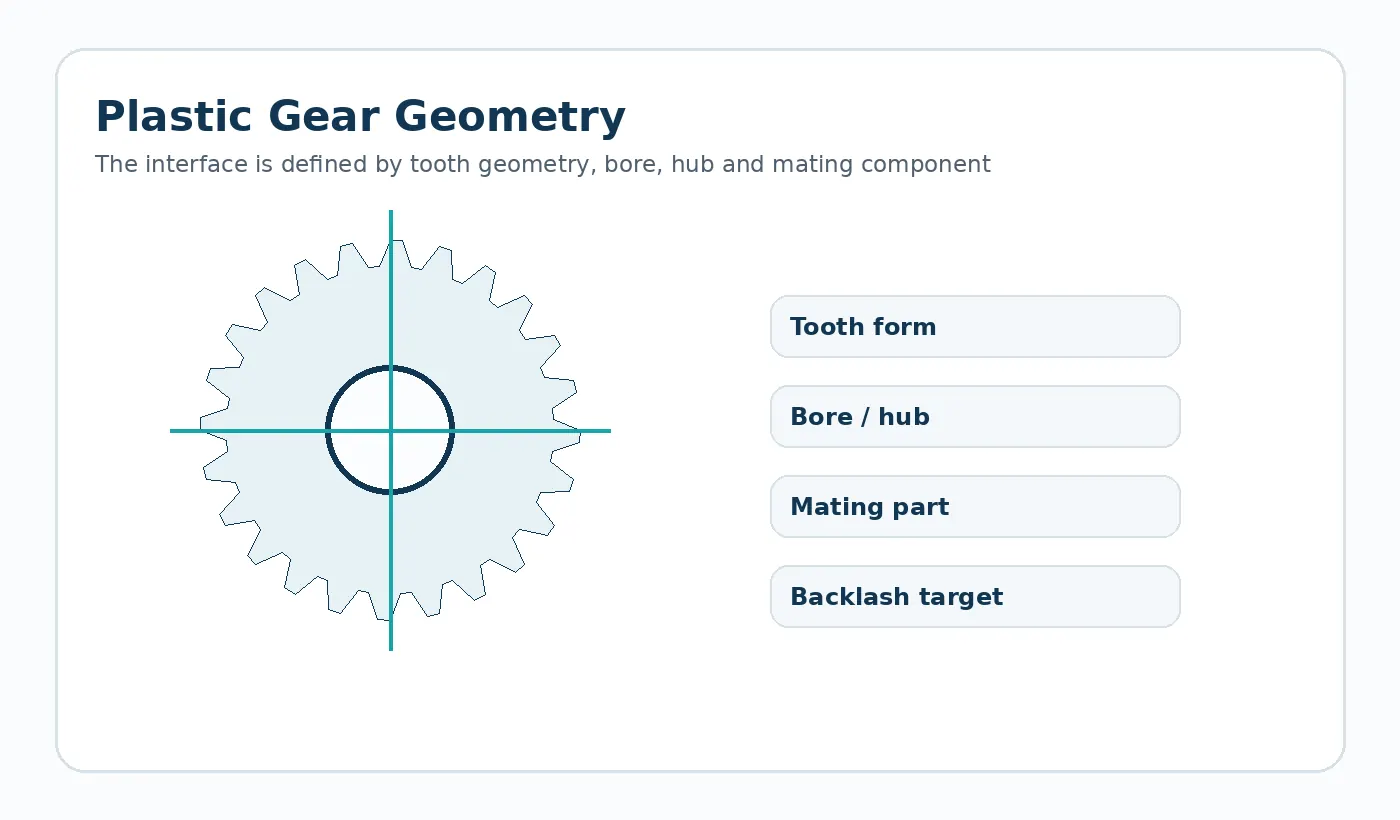
What the drawing needs to communicate
Review tooth geometry together with hub diameter, web thickness, bore features, gate location, parting line and the expected shrinkage of the selected resin.
По возможности, указывайте эти данные на чертеже, в спецификации или в приложении к запросу предложений. Избегайте неформальных обсуждений, это упростит сравнение поставщиков и последующее внесение изменений.
Risk review
Late changes to hub or wall geometry can move the process window after the gear tooth design was already frozen.
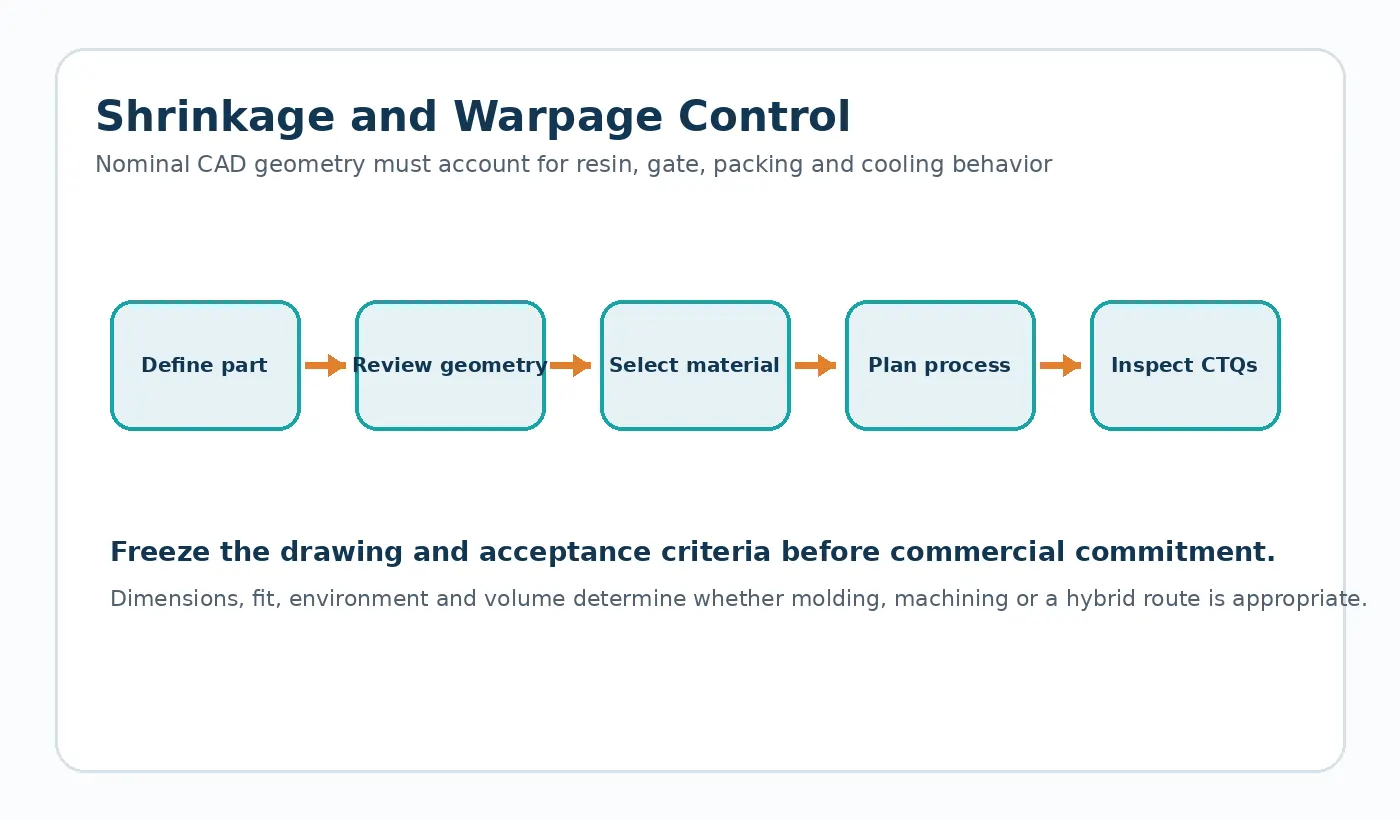
Sample acceptance
Inspect first samples for both gear characteristics and molded-part effects such as runout or distortion.
For Plastic Gear Design for Injection Molding, close the DFM loop by updating the controlled CAD/drawing and sample plan. A recommendation that never reaches the released revision cannot be inspected consistently in production.
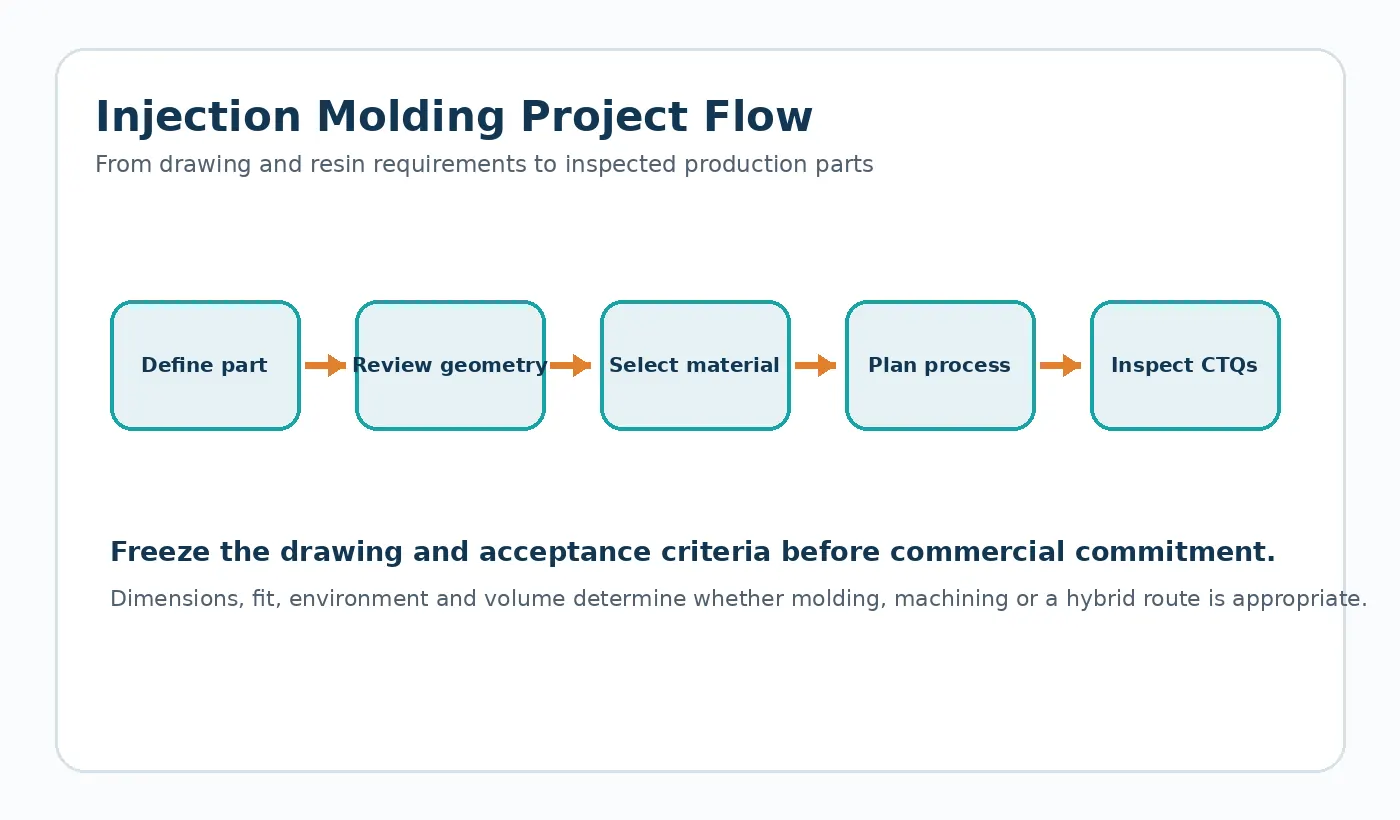
From design review to RFQ
Before requesting a price for plastic gear design for injection molding, identify the current drawing revision, production quantity, material constraint and the feature that most strongly affects function. Ask the supplier to flag any deviation from those inputs in the quotation so technical alternatives stay visible.
Практический анализ проекта для принятия данного решения.
Material selection should connect the polymer to the function and manufacturing route. Review temperature, moisture, chemicals, stiffness, wear pair, dimensional stability and exact grade requirements. A material that performs well in isolation can still be a poor choice when the mating surface or inspection condition is different.
Зафиксируйте допущения на чертеже или в запросе предложений, чтобы поставщик мог подтвердить их до составления коммерческого предложения. Если значение неизвестно, обозначьте его как незавершенную инженерную задачу, а не копируйте общий каталожный номер, который может не соответствовать сборке.
Лист проверки
- Service temperature
- Moisture / chemical exposure
- Load and stiffness need
- Wear pair / lubrication
- Dimensional-stability priority
- Exact grade or approved substitution limits
Используйте первый образец для подтверждения этих пунктов, используя как данные о размерах, так и соответствующую функциональную проверку. Любое допустимое отклонение должно быть зафиксировано в контролируемой версии перед повторным производством.